Assessment of the Abdominal Profile Index (API)

When observing individually marked birds (whether a tagged swan or simply a colour-ringed individual), it is valuable to make a standardised assessment of their fat reserves, as these reflect the general condition of the bird. A large proportion of fat reserves are stored as abdominal fat in the bird’s lower body (abdomen). The amount of this stored fat can be visually estimated in the field by examining the bird’s abdominal profile. This is recorded as the Abdominal Profile Index (API; sometimes also called the condition or fat index). Originally developed for geese (Owen 1981), this technique was later applied to the Bewick’s swan (Bowler 1994).

Slim (left) and well-fed Bewick’s swan (right).
© L. Vergin/H.-J. Augst
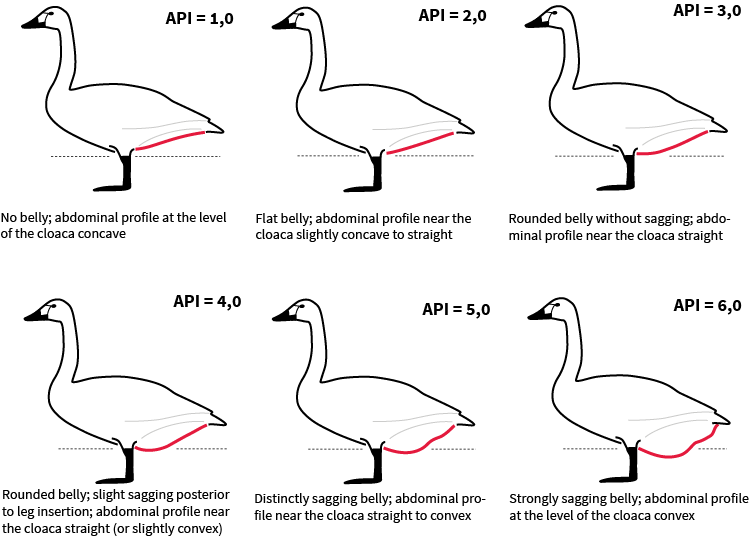
Based on Bowler’s original 6-class-scale but further adapted to better fit forms of abdominal profiles as observed in the field, new revised illustrations were prepared (by G. Eichhorn & F. Mohrwinkel at NABU, Germany). Please refer to these revised illustrations and descriptions as a reference when scoring the Abdominal Profile Index (API). Additionally, you can download silhouettes, where you can draw the abdominal profile line yourself, as a practical exercise that helps familiarizing with profile differences and for recording observations in the field.

It is recommended to observe the animal for a sufficiently long period in the field, ensuring that it is in a favorable position for assessment: side-on to the observer, in a relaxed posture (not in a tense position when alarmed or pulling at food items, because contracted belly muscles may change the profile). Note that when assessing the API, the score given should always reflect the relative volume of fat stored in the abdomen, while the exact shape of the profile line is less relevant.

Printable templates for use in the field can be downloaded below.

© NABU/F. Mohrwinkel; Fotos: L. Vergin (1,5/2,5/5), Bart van Lith/NIOO-KNAW (2/3/3,5/4), H.-J. Augst (4,5)

Downloads

Overview of the API levels “to go”. The redrawing of the silhouettes largely follows Bowler 1994, but is adapted to the shapes of profile lines that we have actually observed.

Download

Worksheet for field observations without pre-drawn abdominal profiles, allowing you to record them yourself.

Download

  • Bowler, J.M. (1994) The condition of Bewick`s Swans Cygnus columbianus bewickii in winter as assessed by their abdominal profiles. Ardea 82: 241-248.
  • Owen, M. (1981) Abdominal profile – a condition index for wild geese in the field. Journal of Wildlife Management 45: 227-230.